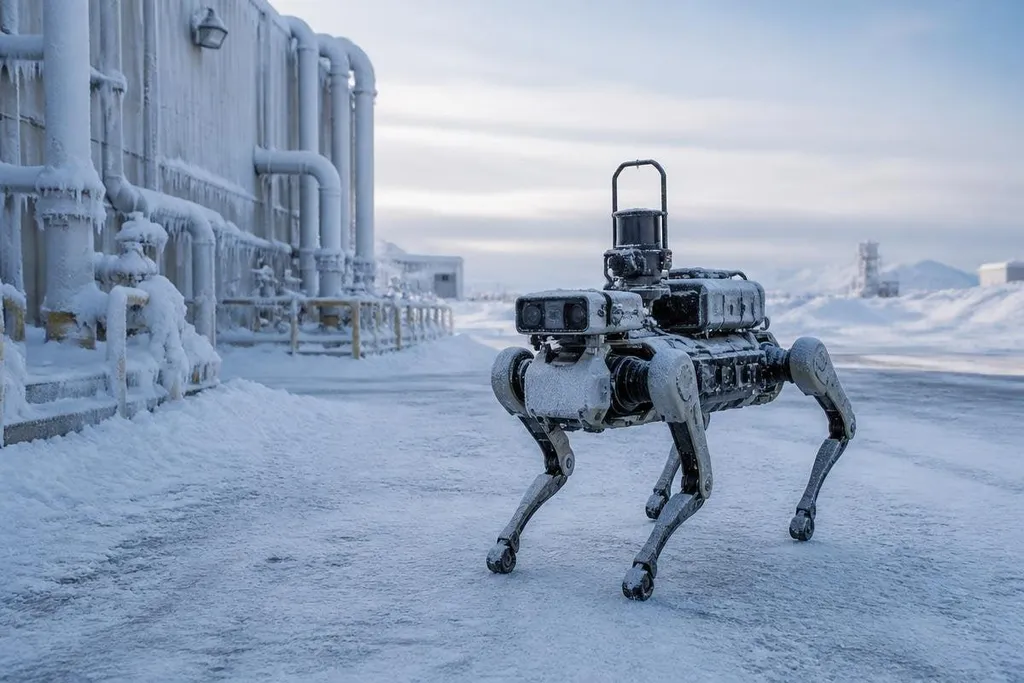
At 0°C, water freezes, batteries lose some output, and many materials become less forgiving. A robot working in a freezer or outside during winter needs changes to its power system, seals, sensors, and moving parts. The main question is whether it can keep doing its job after the cold affects every layer of the machine.
Quick read
- Cold reduces battery output and can limit charging.
- Water and ice can block sensors, joints, and drive parts.
- Traction, sealing, and warm-up time matter as much as the robot’s software.
What cold does to the power system
Battery chemistry slows in low temperatures. A lithium-ion battery may send less current, which can reduce motor force and shorten the time between charges. The robot may still report a full charge while its usable output falls under load.
Charging a cold battery can cause damage, so many systems warm the battery before charging. That takes energy and adds waiting time. A robot that works for one shift in a warm building may need a larger battery, a heated battery box, or planned charging stops in a cold site.
The power draw also rises when motors and gearboxes face thicker fluids or higher resistance. A drive motor that moves easily at room temperature may need more current to start in a cold warehouse. The control system must watch temperature, current, and battery voltage together rather than trust one reading.
Seals, water, and ice
Freezing work brings more than low air temperature. Snow, slush, condensation, and wash water can enter gaps around wheels, arms, cable ports, and sensor windows. When that water freezes, it expands and can block a joint or prevent a cover from closing.
An IP rating describes protection from dust and water under test conditions. It doesn’t prove that a robot can handle repeated freezing, thawing, vibration, and ice buildup. Ask how the maker tested seals across those temperature changes, and ask where the drain paths are.
Condensation creates another problem. When the robot moves from a cold room into warm air, water can collect inside its covers. The safest operating plan may require a warm-up period before power is applied, especially after the robot has spent hours below 0°C.
Sensors and movement
Cameras can fog when their covers change temperature. LiDAR windows can collect frost, while ultrasonic sensors may return poor readings when ice covers their faces. Movement may continue, but the map and obstacle checks can become unreliable.
Wheels and tracks lose grip when ice sits between the tread and the floor. Rubber can also become harder in the cold, changing the contact patch. The result is less braking control and more wheel slip, even when the floor looks clear.
Joints face their own limits. Grease can thicken, seals can stiffen, and cable insulation can lose flexibility. These changes raise the force needed to move an arm or steer a mobile robot. A cold-rated design needs lubricants, cables, and bearings chosen for the actual temperature range.
A low-temperature rating still leaves the test conditions open. Reports on cold-weather robots can give you named machines and operating details to compare before the next section checks what the robot needs before work starts.
What the robot needs before work starts
A cold robot should not move from a specification sheet straight into a production shift. Check the complete operating plan:
- Set the temperature range: Record the lowest air temperature, floor temperature, and storage temperature.
- Check charging rules: Confirm the lowest safe charging temperature for the battery pack.
- Protect sensor faces: Add heaters, covers, or cleaning steps where frost can block readings.
- Test traction: Run braking and turning checks on the real floor after ice, snow, or wash water appears.
- Plan warm-up time: Measure how long the robot needs before its battery, joints, and sensors work normally.
These checks expose a common gap between a lab test and a work site. A robot may function in cold air while failing when water freezes on a wheel encoder or sensor cover.
The failure is tied to the whole machine, not the thermometer alone.
What remains unproven
A maker’s cold-temperature rating may cover startup, storage, or short operation. Those are different claims. You need to know how long the robot ran, how often it entered a warmer area, whether the battery was heated, and how the maker checked sensor accuracy.
Long-term wear is harder to judge. Repeated thawing can stress seals, loosen fasteners, and move moisture into cable paths. A short demonstration can show that a robot moves through cold air; it can’t prove that the same robot will run through a winter of daily shifts.
I'd treat cold-weather operation as a site test, not a box on a product sheet. The machine is ready when it can start, charge, sense, brake, and recover on the coldest part of the actual job, with a recorded warm-up time and a clear stop rule.